
Learning how to read a ruler accurately is one of those foundational skills that seems simple but can dramatically impact precision in school, DIY work, design, engineering, and even everyday tasks. Whether you’re measuring a notebook, cutting fabric, or working on a project, even a tiny mistake can throw off results.
This comprehensive guide will walk you through everything from basics to expert tips so you can measure like a pro.
Table of Contents
What Is a Ruler & Why Accuracy Matters
A ruler is a measuring tool used to determine the length, width, or height of objects, typically marked in inches (imperial system) or centimeters (metric system).
Why accuracy matters:
- Avoid costly mistakes in construction or design
- Ensure proper fitting (furniture, clothes, etc.)
- Improve academic and technical performance
- Maintain consistency in professional work
Even a 1–2 mm error can affect outcomes in precision tasks.
Types of Rulers You Should Know
| Type of Ruler | Measurement System | Common Use | Accuracy Level |
| Standard School Ruler | Inches + cm | Students, basic tasks | Medium |
| Engineering Ruler | Decimal inches | Drafting, design | High |
| Tailor’s Tape | Flexible cm/inches | Sewing, body measurement | Medium |
| Steel Ruler | Inches + mm | Industrial, mechanical work | Very High |
| Digital Ruler | Electronic | Advanced precision work | Ultra High |
Understanding the Parts of a Ruler
Before reading measurements, you need to understand the markings.
Key components:
- Zero line (start point)
- Major markings (inch/cm numbers)
- Minor markings (fractions or millimeters)
- Dual scale (inches + metric on same ruler)
Most rulers have centimeters on one side and inches on the other.
Metric vs Imperial Ruler (Quick Comparison)
| Feature | Metric Ruler | Imperial Ruler |
| Main Unit | Centimeter (cm) | Inch (in) |
| Subdivisions | 10 mm per cm | Fractions (1/2, 1/4, etc.) |
| Ease of Use | Easier (decimal-based) | Harder (fraction-based) |
| Usage | Worldwide | Mostly USA |
Metric rulers are easier because they use base-10 divisions.
How to Read a Ruler Accurately (Step-by-Step)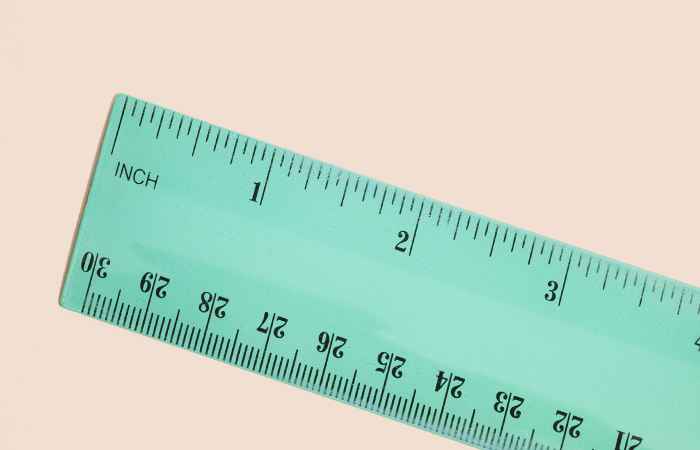
Step 1: Identify the Measurement System
- Look for cm/mm or inches
- Choose one side of the ruler
Step 2: Start at Zero
Always align the object with the 0 mark, not the edge.
Misalignment is the number one cause of measurement errors.
Step 3: Read the Whole Units
- Large numbers = inches or centimeters
Example:
Object ends at 5 → 5 cm or 5 inches
Step 4: Read the Smaller Lines
Metric Ruler:
- Each small line = 1 mm
- 10 mm = 1 cm
Example:
5 cm + 3 small lines = 5.3 cm (53 mm)
Imperial Ruler:
Each inch is divided into fractions:
| Line Size | Value |
| Longest | 1 inch |
| Medium-long | 1/2 inch |
| Medium | 1/4 inch |
| Small | 1/8 inch |
| Smallest | 1/16 inch |
Example:
2 inches + 4 small lines (1/16 each) = 2 1/4 inches
Common Measurement Errors (And Fixes)
| Mistake | Why It Happens | Fix |
| Starting at edge, not zero | Worn ruler edges | Always use zero line |
| Parallax error | Viewing at an angle | Look directly above |
| Misreading fractions | Confusing lines | Learn fraction hierarchy |
| Using wrong scale | Mixed cm/inches | Double-check units |
Keeping your eye directly above the mark avoids parallax error.
Pro Tips to Read a Ruler Like an Expert
Accuracy Tips:
- Use good lighting
- Keep ruler flat
- Measure twice
- Use magnifier if needed
Speed Tips:
- Memorize fraction positions
- Practice with real objects
- Convert fractions to decimals
Fraction to Decimal Conversion Table
| Fraction | Decimal | mm Equivalent |
| 1/2 | 0.5 | 12.7 mm |
| 1/4 | 0.25 | 6.35 mm |
| 1/8 | 0.125 | 3.175 mm |
| 1/16 | 0.0625 | 1.587 mm |
Accuracy Breakdown (Common Error Causes)
- Misalignment: 35%
- Parallax Error: 25%
- Wrong Unit: 20%
- Fraction Confusion: 20%
Most errors come from incorrect starting point and viewing angle.
Real-Life Examples of Reading a Ruler
1 (Metric)
Object ends at:
7 cm + 6 mm
Answer: 7.6 cm
2 (Imperial)
Object ends at:
3 inches + 1/8
Answer: 3.125 inches
3 (Mixed Use)
10 cm = 100 mm
1 inch = 2.54 cm
Practice Table (Try Yourself)
| Object | Ruler Reading | Answer |
| Pencil | 6 cm + 2 mm | 6.2 cm |
| Book | 8 inches + 1/4 | 8.25 in |
| Phone | 15 cm | 15 cm |
Advanced Concepts (For Better Accuracy)
- Parallax Error
Occurs when you view the ruler at an angle.
Fix: Keep your eye directly above measurement.
- Calibration Error
Cheap rulers may be slightly inaccurate.
Some real-world observations show rulers can have 0.5–1 mm variation.
- Measuring Without Zero
If zero is damaged:
- Start from 1 cm
- Subtract 1 cm from final reading
Tools Comparison (Accuracy vs Cost)
| Tool | Accuracy | Price Range (₹) | Best For |
| Plastic Ruler | Medium | ₹20–₹100 | Students |
| Steel Ruler | High | ₹150–₹500 | Engineering |
| Digital Caliper | Very High | ₹800–₹3000 | Precision work |
| Measuring Tape | Medium | ₹100–₹500 | DIY |
Metric vs Imperial: Which Should You Use?
| Situation | Best Choice |
| School & science | Metric |
| DIY home projects | Both |
| Engineering | Metric or decimal inches |
| International work | Metric |
Metric is simpler due to the base-10 system.
Quick Cheat Sheet
- Start at zero
- Identify units (cm or inches)
- Read whole number
- Add smaller divisions
- Double-check
FAQs
- Why are there so many lines on a ruler?
They represent smaller measurement units like fractions or millimeters. - Which is easier: cm or inches?
Centimeters, because they use decimals instead of fractions. - What is the smallest unit on a ruler?
Metric: 1 mm
Imperial: usually 1/16 inch - Can rulers be inaccurate?
Yes, especially cheaper ones or those with worn edges.
Final Thoughts
Mastering how to read a ruler accurately is a small skill with a big impact. From schoolwork to professional tasks, precision matters and once you understand the markings, it becomes second nature.
The key is simple:
- Align correctly
- Understand divisions
- Practice regularly
See Also: Artificial Intelligence(AI) – Definition, Examples, History, And More