
In the world of software testing, identifying bugs efficiently is critical to delivering reliable applications. Among the many test design techniques, boundary value analysis in testing (BVA) stands out as one of the most practical and widely used methods.
Why? Because most software defects occur at the edges of input values—not in the middle.
This guide provides a deep, research-backed understanding of boundary value analysis, including its concepts, real-world examples, advantages, limitations, and comparison with other testing techniques.
Table of Contents
What is Boundary Value Analysis in Testing?
Boundary Value Analysis (BVA) is a black-box testing technique that focuses on testing input values at the boundaries of valid and invalid ranges.
Instead of testing every possible input (which is inefficient), BVA targets:
- Minimum value
- Just above minimum
- Nominal (typical value)
- Just below maximum
- Maximum value
- Just outside boundaries (invalid cases)
The core idea is simple:
Software is more likely to fail at extreme values than at mid-range values.
Why Boundary Value Analysis is Important
Testing every input combination is impractical. BVA helps reduce effort while maintaining high defect detection.
Key Reasons:
- Detects edge-case bugs quickly
- Reduces number of test cases
- Improves test coverage
- Saves time and cost
- Enhances software reliability
According to testing research, focusing on boundary conditions significantly increases the chances of finding defects because errors often occur near input limits .
Core Concept of Boundary Value Analysis
Every input domain can be divided into ranges (partitions).
Each partition has:
- Minimum value
- Maximum value
These are called boundary values.
Example:
If a system accepts values from 1 to 100, the boundaries are:
| Type | Value |
| Below Minimum | 0 |
| Minimum | 1 |
| Just Above Minimum | 2 |
| Just Below Maximum | 99 |
| Maximum | 100 |
| Above Maximum | 101 |
Instead of testing all 100 values, BVA tests these critical points.
Types of Boundary Value Analysis
Boundary value analysis can be applied in multiple ways depending on testing depth.
1. Standard Boundary Value Analysis
Tests:
- min
- min + 1
- max – 1
- max
2. Robust Boundary Value Analysis
Includes invalid values:
- min – 1
- max + 1
3. Worst-Case Boundary Value Analysis
Tests combinations of multiple variables simultaneously.
Boundary Value Analysis Example (Real-World)
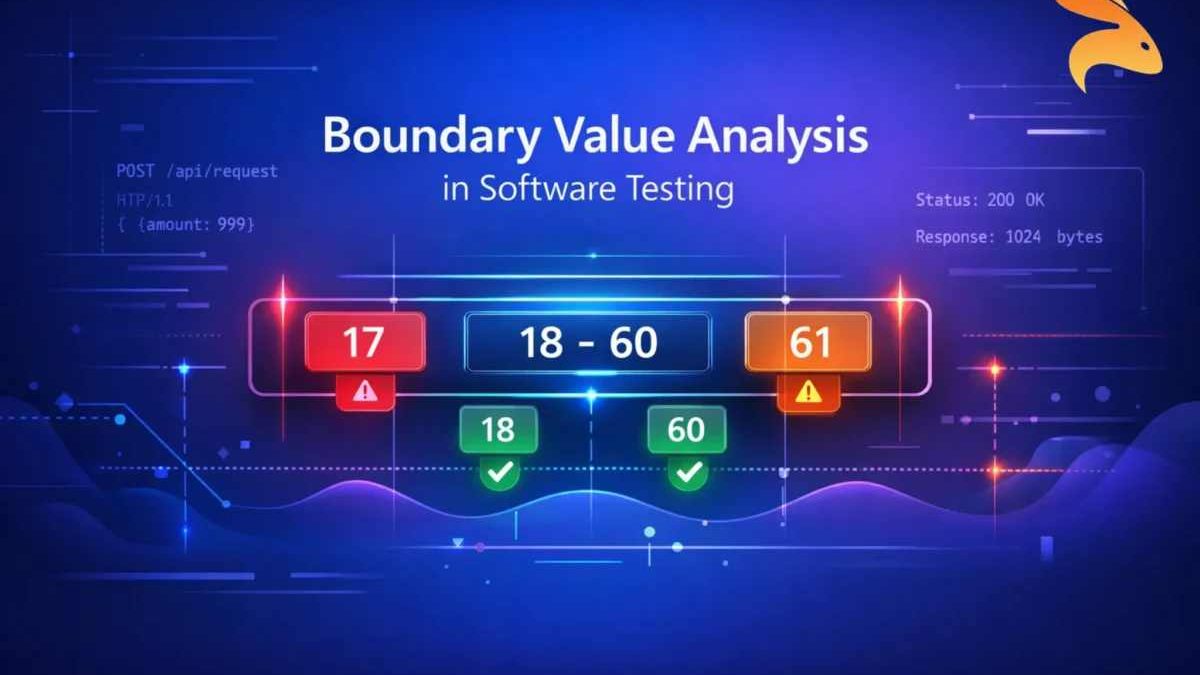
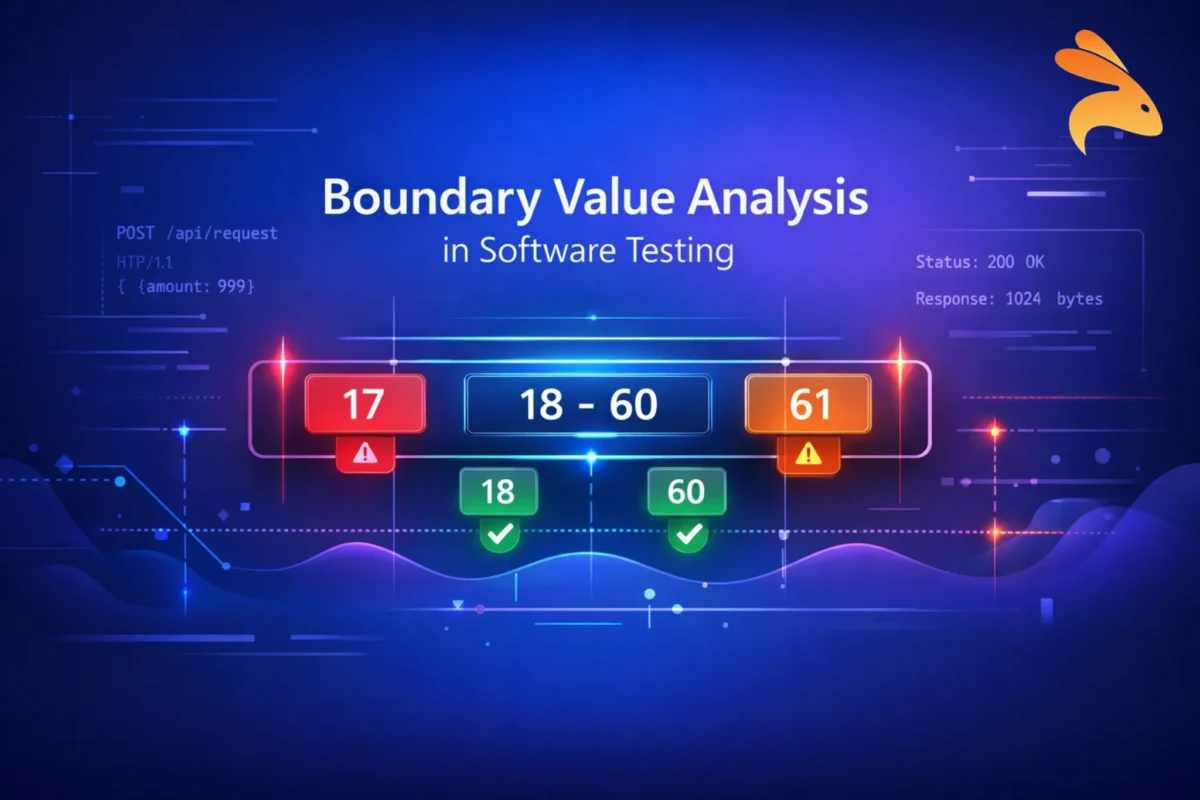
Scenario: Age Validation System
Requirement:
- Accept age between 18 and 60
Test Cases:
| Test Case Type | Input | Expected Result |
| Below Min | 17 | Invalid |
| Minimum | 18 | Valid |
| Just Above Min | 19 | Valid |
| Nominal Value | 35 | Valid |
| Just Below Max | 59 | Valid |
| Maximum | 60 | Valid |
| Above Max | 61 | Invalid |
This aligns with standard BVA practice where both valid and invalid boundaries are tested .
Step-by-Step Process to Perform Boundary Value Analysis
Follow this structured approach:
1: Identify Input Variables
- Example: age, password length, price, etc.
2: Define Valid Range
- Example: 1–100, 8–12 characters
3: Identify Boundary Values
- min, max, min-1, max+1
4: Design Test Cases
- Include valid and invalid values
5: Execute Tests
- Observe system behavior
6: Analyze Results
- Identify defects and inconsistencies
Boundary Value Analysis vs Equivalence Partitioning
These two techniques are often used together.
| Feature | Boundary Value Analysis | Equivalence Partitioning |
| Focus | Edge values | Input ranges |
| Test Cases | Fewer but critical | Reduced groups |
| Defect Detection | High at edges | General validation |
| Complexity | Simple | Moderate |
Key Insight:
BVA is essentially an extension of equivalence partitioning that focuses on edges of partitions .
Advantages of Boundary Value Analysis
1. High Defect Detection Rate
Most bugs occur at boundaries due to:
- Incorrect conditions
- Off-by-one errors
- Logical mistakes
2. Reduced Testing Effort
Instead of testing 100 inputs, you test ~6 values.
3. Improved Test Coverage
Ensures critical edge cases are not missed.
4. Cost Efficiency
| Testing Approach | Estimated Effort | Bug Detection Rate |
| Exhaustive Testing | Very High | Very High |
| Random Testing | Medium | Low |
| Boundary Value Analysis | Low | High |
Disadvantages of Boundary Value Analysis
Despite its benefits, BVA has limitations.
- Limited Scope
It ignores mid-range values, which may also contain defects .
- Not Suitable for Complex Systems
Systems with:
- Multiple dependencies
- Dynamic inputs
may require additional techniques.
- Requires Clear Requirements
Undefined boundaries make BVA ineffective.
Common Mistakes in Boundary Value Testing
Avoid these pitfalls:
- Ignoring invalid boundaries (min-1, max+1)
- Not testing all variables
- Misinterpreting requirements
- Over-relying on BVA alone
- Skipping combination testing
Practical Use Cases of Boundary Value Analysis
BVA is widely used in:
- Form Validation
- Age input
- Password length
- Email field
- E-commerce Systems
- Price limits
- Discount ranges
- Quantity restrictions
- Banking Applications
- Transaction limits
- Withdrawal ranges
- Healthcare Systems
- Dosage limits
- Age restrictions
Visual Breakdown
To understand test distribution, imagine a pie chart of test cases:
- 60% → Boundary values
- 25% → Near-boundary values
- 10% → Nominal values
- 5% → Random testing
This shows how BVA prioritizes edge testing for maximum efficiency.
Boundary Value Analysis Test Case Template
Use this reusable template:
| Test ID | Input Variable | Min | Max | Test Value | Expected Output |
| TC01 | Age | 18 | 60 | 17 | Invalid |
| TC02 | Age | 18 | 60 | 18 | Valid |
| TC03 | Age | 18 | 60 | 19 | Valid |
| TC04 | Age | 18 | 60 | 59 | Valid |
| TC05 | Age | 18 | 60 | 60 | Valid |
| TC06 | Age | 18 | 60 | 61 | Invalid |
Advanced Concepts in Boundary Value Analysis
- Single Variable BVA
Testing one input at a time.
- Multiple Variable BVA
Testing combinations of inputs.
- Robust Testing
Includes invalid scenarios.
Tools That Support Boundary Value Analysis
Although BVA is conceptual, tools help automate it:
- Selenium
- JUnit
- TestNG
- Postman
These tools allow testers to execute boundary test cases efficiently.
Real-Life Example (Password Validation)
Requirement:
- Password must be 8–12 characters
Test Cases:
| Input Length | Expected Result |
| 7 | Invalid |
| 8 | Valid |
| 9 | Valid |
| 11 | Valid |
| 12 | Valid |
| 13 | Invalid |
This example demonstrates how BVA catches validation issues quickly.
When Should You Use Boundary Value Analysis?
Use BVA when:
- Input ranges are clearly defined
- Numeric or measurable inputs exist
- Validation logic is present
- System has constraints
Avoid using BVA alone when:
- Complex business logic exists
- Inputs are unstructured
Best Practices for Boundary Value Analysis
- Combine with equivalence partitioning
- Always test invalid boundaries
- Automate repetitive test cases
- Validate requirements carefully
- Include both positive and negative tests
Boundary Value Analysis in Agile Testing
In Agile environments:
- BVA is used during sprint testing
- Helps in early defect detection
- Improves CI/CD pipelines
Early detection reduces cost significantly, as fixing bugs later is more expensive .
Key Takeaways
- Boundary Value Analysis focuses on edge values
- It is a black-box testing technique
- Reduces test cases while maximizing efficiency
- Best used with equivalence partitioning
- Essential for validation-heavy applications
Final Thoughts
Boundary value analysis in testing is not just a technique it’s a mindset. Instead of testing everything, you test what matters most.
By focusing on boundaries, testers can:
- Detect critical defects early
- Improve software quality
- Optimize testing effort
Whether you are a beginner or an experienced QA engineer, mastering BVA is essential for building reliable and robust software systems.